Most commercial property owners don’t think about their parking lot until something goes wrong. A tenant complains, a visitor damages a vehicle, or someone threatens a personal injury claim after tripping on a broken edge. That’s usually when the phone calls start.
It’s understandable. A parking lot surface doesn’t announce its problems the way a leaking roof or broken HVAC system does. It deteriorates quietly over months and years — a crack here, some edge deterioration there, faded line markings. Nothing that feels urgent… until suddenly it does.
The reality is that parking lot surface maintenance is one area where staying ahead of problems is dramatically cheaper than reacting to them. A crack sealed today costs a fraction of the pothole repair it becomes next winter. Clearing drainage this month prevents surface damage caused by standing water over the following year.
This guide from Property Maintenance Hub covers the main parking lot surface types, how each one deteriorates, what a realistic maintenance program looks like, and when it’s time to move from maintenance to resurfacing.
The Three Main Parking Lot Surface Types
Asphalt (Most Common) Asphalt is the most widely used surface on commercial and industrial parking lots. It’s relatively quick to install, cost-effective, and has some flexibility to handle minor ground movement. However, it’s not a “set-it-and-forget-it” surface. The bitumen binder oxidizes over time due to UV exposure, causing the surface to gray, become brittle, and develop cracks or surface raveling (where aggregate breaks loose).
A well-maintained asphalt parking lot typically lasts 20–30 years.
Concrete Concrete is increasingly popular on new developments, especially multi-level structures and large retail or industrial sites. A properly installed concrete lot can last 30–40 years and doesn’t soften in extreme heat like asphalt can.
The downside: Concrete is rigid. It cracks when the ground moves, repairs are more visible, and expansion joints require regular attention. When concrete fails, repairs are generally more expensive than asphalt.
Interlocking Pavers Pavers are common on smaller commercial sites, hotel entrances, and areas where appearance matters. They look attractive, allow water to drain through joints, and individual damaged pavers can be replaced easily.
However, they require more ongoing maintenance: periodic re-sanding of joints, weed control, and re-leveling when pavers shift under heavy traffic.
How Parking Lot Surfaces Deteriorate
Water is involved in almost every failure. On asphalt, it enters cracks, softens the sub-base, and triggers the freeze-thaw cycle that turns small cracks into potholes. On concrete, it penetrates failed joints and corrodes reinforcement, causing spalling. On pavers, it washes out joint sand and causes uneven settling.
Heavy Vehicle Traffic accelerates wear. Delivery trucks, garbage trucks, and construction equipment create much higher axle loads than standard cars. Areas with frequent turning movements (entrances, ramp tops, and ends of parking rows) show wear first.
Age and Oxidation make asphalt brittle over time. Periodic surface treatments can significantly extend its life by restoring flexibility and sealing against water.
Vegetation growing through cracks is a structural issue — roots widen cracks from below. Moss and algae also create slip hazards and retain moisture against the surface.
Pro Tip from Property Maintenance Hub: A small crack sealed today is far cheaper than a pothole repair next year.
🔗 Internal link: Read our guide on parking lot pothole repair
Realistic Parking Lot Surface Maintenance Program
The most effective programs are simple enough to actually follow consistently.
Monthly
- Visual walk of the entire parking lot
- Look for new cracks, edge deterioration, drainage issues, or changes since last month
- Photograph anything new and keep a simple log
Every 3–6 Months
- Clear all drainage channels, catch basins, and curb-edge debris
- Ensure water flows off the surface properly with no pooling
- Increase frequency in autumn if there is significant tree cover
Annually
- Detailed inspection (ideally with a surfacing contractor)
- Crack mapping — note location, width, and whether cracks are growing
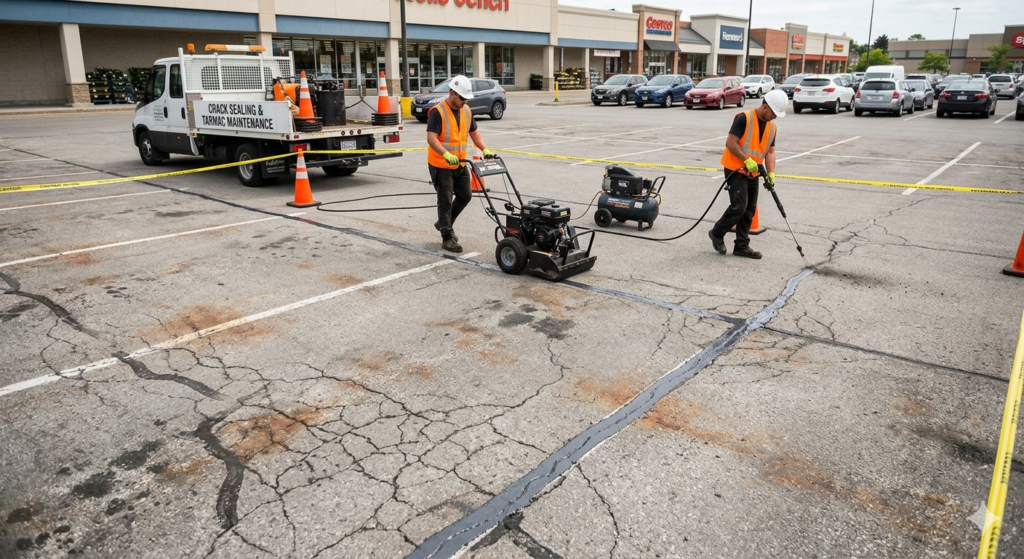
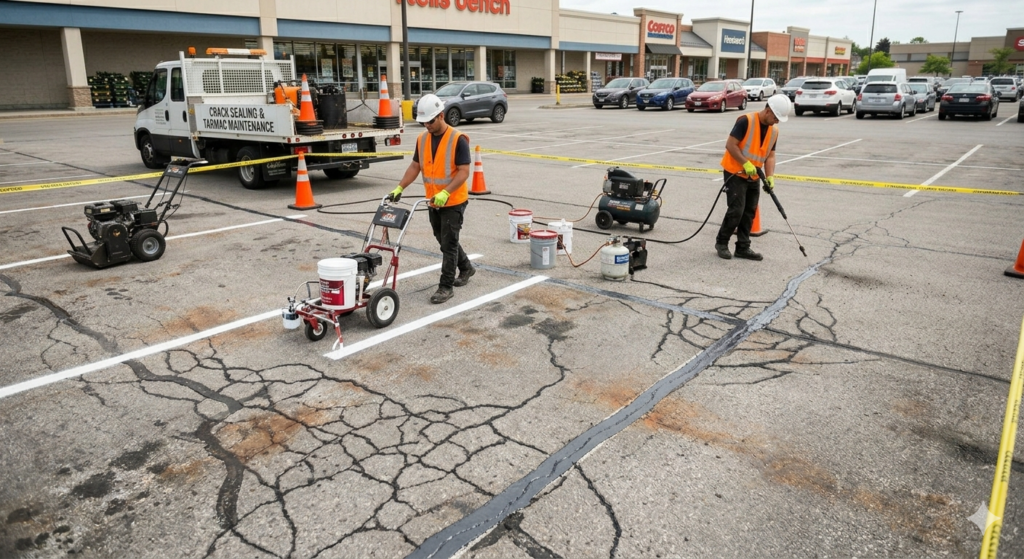
- Perform crack filling, joint sealing, and localized repairs
Every 3–5 Years
- Asphalt surface treatment (rejuvenator or surface dressing) — restores flexibility, seals against water and oxidation, and extends lifespan significantly. One of the most cost-effective interventions available.
As Needed
- Refresh line striping every 3–5 years (faded markings create safety and liability issues, especially around pedestrian zones and accessible parking)
Concrete Parking Lot Maintenance: Key Differences
Corrosion staining (rust-colored streaks) indicates water has reached the reinforcement — address promptly before spalling occurs.
Expansion joints are critical. When the sealant fails, water enters, erodes the sub-base, and causes edge cracking and spalling.
Surface cracking must be assessed: hairline surface cracks are usually cosmetic; through-slab cracks with differential movement suggest sub-base problems and need professional evaluation.
Interlocking Paver Maintenance
Address weeds promptly — they destabilize the bedding layer
Re-sand joints every 2–3 years (use kiln-dried or polymeric sand for better weed resistance)
Lift and re-level any rocking or uneven pavers before settlement spreads
When Maintenance Is No Longer Enough
There comes a point where continued maintenance is no longer cost-effective. Consider resurfacing when:
- Asphalt: Widespread interconnected cracking, multiple failing patches, or repeated pothole formation
- Concrete: Widespread joint failure, extensive reinforcement corrosion, or significant differential settlement
- Pavers: Bedding layer failure across more than 20–30% of the surface
A reputable contractor can give you an honest assessment of whether your surface is still worth maintaining or if resurfacing makes more financial sense.
Often-Overlooked Areas
- Accessible parking spaces and curb ramps — receive heavy foot traffic and have legal accessibility implications
- Lighting and CCTV pole bases — common entry points for water if not properly sealed
- EV charging stations — cable routes and mounting points create additional penetration points that need regular sealant checks
Final Thoughts
Parking lot surface maintenance rewards consistency and punishes neglect — usually at the worst possible time and at the highest possible cost.
You don’t need an elaborate program. Monthly visual walks, regular drainage clearing, annual crack assessment, and periodic surface treatments are enough for most commercial properties. The discipline of doing these things consistently is what separates a parking lot that runs smoothly for decades from one that generates surprise repair bills and liability issues.
Start this week. Walk your parking lot, take photos, and begin a simple maintenance log. You’ll either find things are in better shape than you thought — or you’ll catch problems while they’re still small and inexpensive to fix.
Need a professional assessment of your parking lot surface? Visit propertymaintenancehub.blog for expert guides, cost-saving strategies, and practical maintenance resources for commercial properties.
Running a commercial or industrial site and want someone to take a look at your car park surface? Get in touch with our team — we’ll give you a straight assessment of where things stand and what makes sense to do about it.
Leave a Reply