Commercial property exterior maintenance is the part of property management that most owners treat as optional — right up until it produces an expensive problem they didn’t see coming. The building looks fine from the street, the interior systems are being serviced, and the outside can wait. That logic works until the deferred cracks become potholes, the blocked drainage fails a surface, or the faded line markings generate a compliance notice.
This guide covers what actually breaks down on a commercial exterior, why it happens faster than most people expect, and what a realistic maintenance program looks like to stay ahead of it.
Why Commercial Property Exterior Maintenance Gets Skipped
Interior systems fail loudly. A broken HVAC generates tenant complaints within hours. A water heater failure is obvious immediately. Owners and managers fix these things because ignoring them isn’t an option.
Exterior deterioration is quiet. A parking lot surface doesn’t alert you when the first crack appears. Gutters don’t signal when debris blocks them. Line markings don’t warn when they’ve crossed from faded into non-compliant. The decline moves slowly, in steps small enough to dismiss each month, until the whole picture becomes impossible to ignore.
By that point, the repair costs significantly more than earlier attention would have. A crack sealed promptly costs a fraction of the pothole repair it becomes after one winter. That’s not a complicated calculation — it just requires catching the crack while it’s still a crack.
🔗 Internal link: Read our guide on parking lot pothole repair
What Commercial Property Exterior Maintenance Actually Covers
Most people think of the parking lot surface when exterior maintenance comes up. That’s the right starting point — but the scope runs wider.
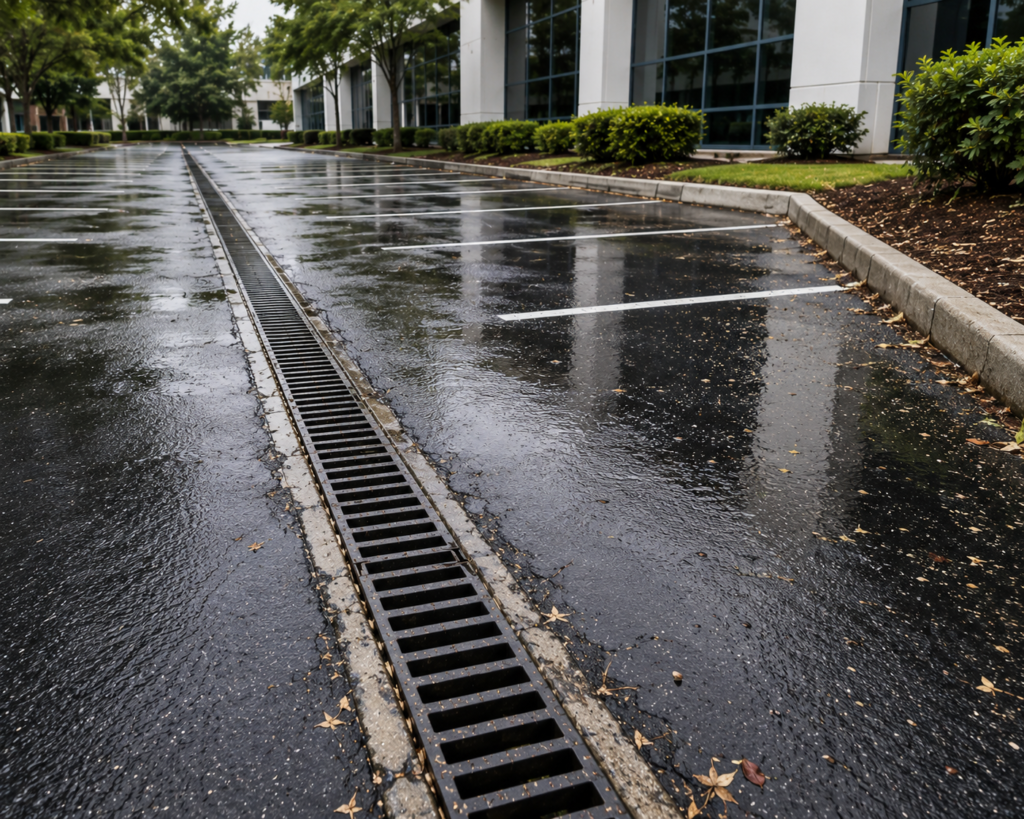
Surface and drainage are one problem, not two. A lot with compromised drainage deteriorates faster than an identical lot where water moves off cleanly after rain. Standing water penetrates surface cracks, softens the sub-base, and in cold climates drives the freeze-thaw cycle that turns small cracks into structural failures. You can’t maintain one without attending to the other.
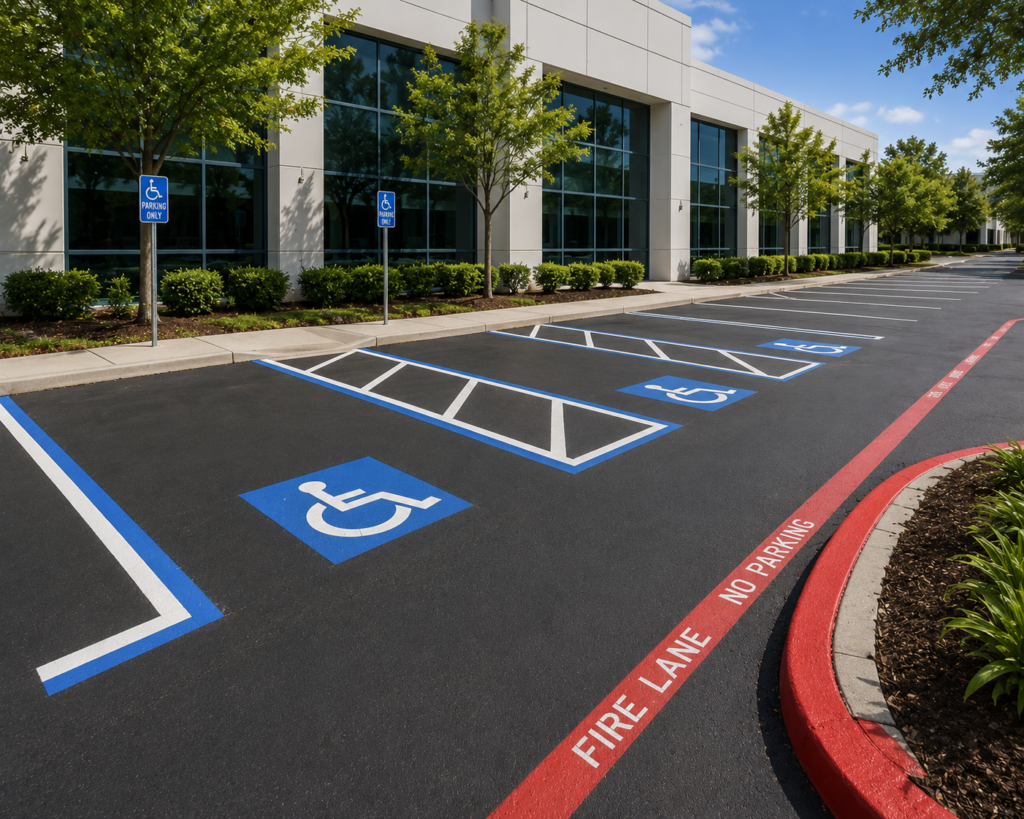
Line markings carry legal weight that surface condition doesn’t. Faded parking stall markings hurt organization. Faded fire lane markings create a fire code problem. Faded or incorrectly configured accessible parking markings create ADA exposure — both through regulatory enforcement and private litigation under Title III of the Americans with Disabilities Act. The ADA National Network provides current guidance on accessible parking requirements for commercial properties, and the standards are more specific than most owners realize.
Building perimeter junctions — where walls meet hardscape, where expansion joints run between the building and the lot surface — are common water entry points that ground-level inspections miss. Water often enters a structure at these junctions and causes internal damage for months before anyone notices.
Lighting column bases, signage posts, and perimeter fencing each create penetration points in the lot surface that need periodic checking for sealant failure. These are easy to walk past during a visual inspection and easy to overlook until water has been tracking through them for a season.
Sweeping: The Maintenance Task Most Owners Undervalue
Of everything in a commercial property exterior maintenance program, scheduled sweeping gets dismissed most readily. It looks cosmetic. It isn’t.
Sweeping does two things at once. First, it removes the grit and debris that acts as an abrasive under vehicle traffic — material that grinds into the asphalt wearing course every time a vehicle moves across it, accelerating surface wear in a way that’s invisible month to month but real over a year. Second, it keeps drainage channels and gully outlets clear, which is the more structurally significant function.
When drainage channels block — and they will, through normal accumulation of debris, leaves, and sediment — water sits on the surface instead of leaving it. That standing water drives the deterioration sequence that ends in resurfacing: penetration through cracks, sub-base saturation, freeze-thaw expansion, pothole formation. A regular sweeping program interrupts that sequence at the start, before it reaches the drains. According to PAVEMENT magazine, regular surface cleaning is one of the highest-return maintenance investments available on a commercial asphalt lot — and one of the most commonly deferred.
Parking Lot Sweeping Pros runs scheduled commercial sweeping programs across Wichita and Tulsa, working around property operating hours with documented service records that support both insurance requirements and maintenance tracking.
🔗 Internal link: Read our full guide on parking lot sweeping for commercial properties
Line Markings and ADA Compliance: What’s Actually Required
Fresh line markings are a visible part of commercial property exterior maintenance — but the compliance dimension is what carries the most financial exposure.
The ADA sets specific requirements for accessible parking on every commercial property open to the public. The number of required accessible spaces scales with total lot capacity. Each space needs correct dimensions. Access aisles — the hatched no-parking zones alongside accessible spaces — must run full-length, be clearly marked, and connect directly to the accessible building entrance route. At least one space must be van-accessible once the required count reaches a certain threshold, with its own dimensional requirements for the aisle.
A lot of commercial properties haven’t had a proper ADA compliance review since their last major repave. The wheelchair symbol is still visible. The access aisle width is technically too narrow. The van-accessible space lacks correct signage. None of this shows from across the lot — but all of it creates documented exposure.
A proper restripe measures the existing layout against current requirements and corrects what doesn’t meet them before painting anything. PrecisionLine Striping includes ADA documentation as a standard part of every commercial restripe — the layout gets verified and recorded, not just repainted.
Building a Maintenance Program That Actually Runs
Most commercial property exterior maintenance programs don’t fail because they don’t exist. They fail because they live on paper and nobody follows them — because the exterior never feels urgent and something always does.
Programs that work share a few traits. Tasks are specific and unambiguous. Individual people own individual items rather than everything sitting as collective responsibility. Budget lines for routine maintenance stay protected rather than getting pulled toward other priorities.
Here’s what a working program looks like in practice:
Every month — walk the entire exterior. Check the lot surface, drainage channels, line marking condition, building perimeter, and lighting column bases. Take photos. Log what you find and the date. That log is your documented maintenance record, and it carries significant weight if a liability claim arises.
Every three months — clear gullies, downspouts, and surface drainage channels. Confirm water moves off the lot after rain without pooling. This check prevents the drainage failures that accelerate surface deterioration fastest.
Every year — assess cracks across the asphalt surface and review line marking condition. Fill cracks before winter. Schedule a restripe for markings approaching illegibility before they cross the compliance threshold, not after.
Every one to two years — full restripe with ADA compliance verification. Not a visual refresh of existing markings — a proper restripe that confirms the layout meets current requirements and produces written documentation.
Every two to three years — professional surface condition assessment. An objective view of where the lot sits in its lifecycle, what maintenance makes sense now, and what capital planning is appropriate.
🔗 Internal link: Read our guide on planned preventive maintenance for commercial properties
Why the Paper Trail Matters
Commercial property liability claims involving exterior conditions almost always come down to one question: did you know about the defect, and what did you do about it?
A property with regular inspection records and documented repairs sits in a different position than one without. Both might have had the same defect. The liability exposure is not the same.
Exterior maintenance isn’t only about keeping the property in good condition. It’s about showing that you kept it in good condition — that someone looked, found things, and fixed them. According to OSHA’s General Duty Clause, employers have a duty to maintain workplaces free from recognized hazards, and documented maintenance programs are the clearest evidence of meeting that standard. That documentation is what turns a liability situation into a defensible one.
Where to Start
If your commercial property exterior doesn’t have a structured maintenance program yet, the starting point is simple. Walk the lot this week. Take photos. Note the surface condition, drainage, line marking legibility, and accessible parking layout. That walk is your first inspection and your baseline for everything that follows.
From there, get two quotes — one for a sweeping contract, one for a restripe with ADA review. Both are straightforward. Most commercial properties find the combined cost of proper commercial property exterior maintenance considerably lower than expected — and much lower than what deferred maintenance eventually produces.
Your exterior works every day for everyone who uses your property. It deserves a program that works just as hard.
Managing a commercial property and not sure where your exterior maintenance stands? Get in touch — we’ll help you build a practical program that fits your site and your budget.
Leave a Reply