If you manage a commercial or industrial site, parking lot sweeping is probably not the thing keeping you up at night. There are bigger concerns — roof repairs, boiler servicing, tenant issues. Sweeping the car park tends to sit at the bottom of the list.
But here’s the thing. Your car park is the first part of your property that anyone sees. Before a customer walks through your door, before a tenant signs a lease, before an inspector sets foot on site — they’ve already driven across your car park. And if it’s covered in litter, grit, oil stains, and debris sitting against blocked drainage channels, that impression sticks.
More importantly, neglecting parking lot sweeping isn’t just an aesthetic issue. It causes real, measurable damage to your surface over time — and that damage is expensive to fix.
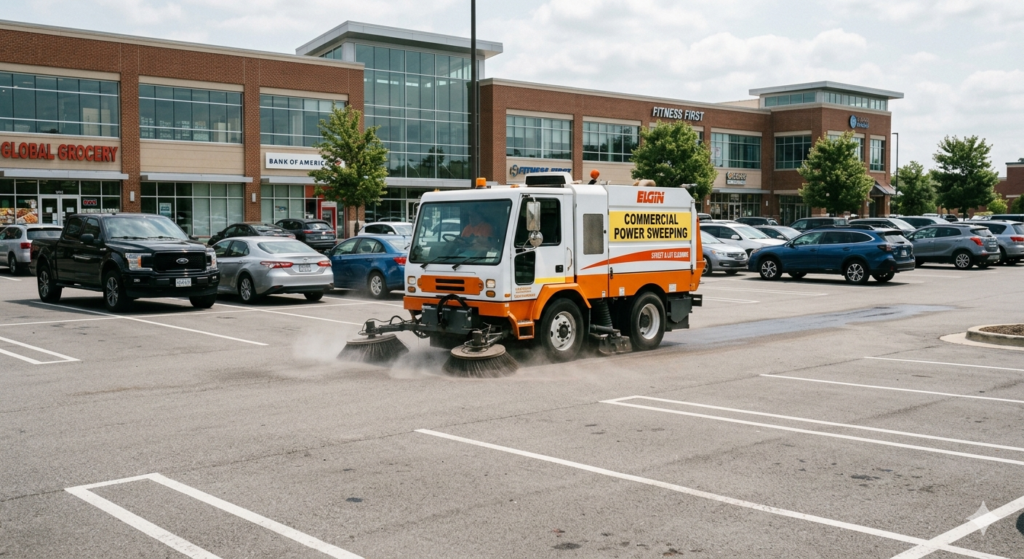
What Actually Happens When You Don’t Sweep
Most people assume a dirty car park is just a dirty car park. In reality, the debris sitting on your surface is actively working against it.
Grit and fine aggregate — the kind that gets tracked in from roads, kicked up by tyres, and deposited by wind — acts like sandpaper under vehicle traffic. Every car that drives over it grinds it into the surface, accelerating wear on the asphalt or concrete wearing course. Over time, this strips away the fine surface layer that protects the binder beneath.
Then there’s the drainage problem. Leaves, litter, and sediment don’t just sit on the surface — they migrate. They collect at the edges of the car park, build up against kerbs, and find their way into drainage channels and gullies. A blocked gully means standing water. Standing water means water sitting on your asphalt, finding cracks, penetrating the sub-base, and beginning the freeze-thaw cycle that turns hairline cracks into potholes.
We’ve written before about the cost of leaving potholes untreated — and in a lot of cases, the root cause traces back to drainage failure that regular parking lot sweeping would have prevented.
Oil and fuel deposits are another issue that doesn’t get enough attention. Vehicles leak. It’s a fact of life in any busy car park. Over time, oil deposits soak into asphalt and begin to break down the bitumen binder — the same binder that holds the surface together. The result is a soft, crumbling surface in localised areas, particularly in bays where vehicles regularly park for long periods.
None of this happens overnight. But it compounds quietly, month after month, until you’re looking at a resurfacing bill that could have been largely avoided.
How Often Should You Sweep Your Car Park?
Honestly, it depends on the site. There’s no single answer that works for every property — a small 20-space car park serving an office block has very different needs to a 400-space retail park or an industrial estate with heavy goods vehicles coming and going around the clock.
That said, here’s a rough framework that works for most sites:
High-traffic retail or leisure sites — weekly sweeping as a minimum. These sites accumulate litter fast, and the reputational impact of a visibly dirty car park is significant for businesses trading from them.
Industrial and warehouse sites — fortnightly, with additional sweeps after periods of heavy activity. Grit, aggregate, and debris from loading operations builds up quickly around loading bays and entrance areas.
Office and business park sites — monthly sweeping is often sufficient, with additional attention in autumn when leaf fall blocks drainage channels rapidly.
Post-event or seasonal sites — a thorough sweep after any period of concentrated use; festivals, markets, or seasonal retail peaks leave behind significant amounts of waste.
The honest answer is that most sites are under-swept. Monthly sweeping is often treated as the standard when weekly or fortnightly would be far more appropriate. It’s worth reviewing your current schedule against what your site actually generates.
Professional Sweeping vs. DIY
There’s a version of this conversation where someone buys a commercial backpack blower and calls it a sweeping programme. It isn’t.
Manual sweeping with brushes and blowers has its place — touching up entrances between professional visits, clearing leaves from walkways, keeping fire exits clear. But it can’t replace a proper mechanical sweep for a number of reasons.
Professional sweeper vehicles — whether ride-on sweepers for larger sites or compact pedestrian sweepers for tighter spaces — use a combination of rotating brushes and vacuum suction to lift debris from the surface, including the fine grit that manual sweeping simply redistributes. They collect and contain it, rather than blowing it into drainage channels or neighbouring areas.
They also clean kerb lines and edges properly. The edges of a car park are where debris accumulates most heavily, and they’re almost impossible to clean thoroughly by hand without an enormous amount of time and effort.
For most commercial sites, a contract with a professional parking lot sweeping company is the most cost-effective approach. You get a regular, documented service — which matters for insurance and compliance records — and the work is done properly by people with the right equipment.
When choosing a contractor, look for:
- Clear documentation of each visit, including date, operative, and areas covered
- Evidence of correct waste disposal — the debris collected during sweeping is classified as controlled waste and must be disposed of legally
- Public liability insurance of at least £5 million
- Experience with your type of site — an industrial estate and a retail car park have very different sweeping requirements
Parking Lot Sweeping and Compliance
This is the part that often surprises people. Parking lot sweeping isn’t just a maintenance preference — in certain contexts, it touches on legal obligations.
Under the Environmental Protection Act 1990 and associated codes of practice, landowners have a duty to keep their land clear of litter and refuse. Local authorities can issue fixed penalty notices for land that is consistently littered or dirty, and while enforcement varies, the legislation is there.
More practically, your public liability insurance policy will typically require you to maintain your site in a safe condition. Debris on a car park surface creates slip and trip hazards — particularly in wet conditions. If someone trips, falls, and makes a claim, and you can’t demonstrate a reasonable maintenance schedule, you’ll find your insurer less sympathetic than you’d like.
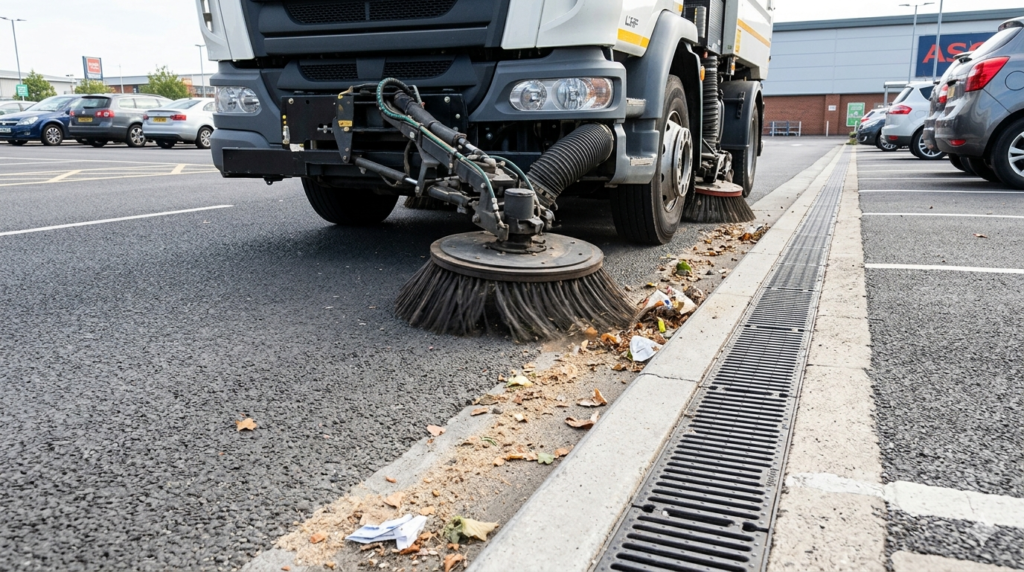
Documented, regular parking lot sweeping is a simple and relatively inexpensive way to demonstrate that you are actively managing your site. Keep records of every visit — dates, contractor details, areas covered. That paper trail is worth far more than its weight if you ever need to defend a liability claim.
What to Include in a Parking Lot Sweeping Specification
If you’re putting together a sweeping contract — or reviewing an existing one — it’s worth being specific about what you want covered. A vague “sweep the car park monthly” instruction will get you vague results.
A proper specification should cover:
- Frequency — how often, and whether any areas require more frequent attention than others
- Scope — which areas are included; car park bays, access roads, pedestrian walkways, loading areas, and perimeter edges should all be listed explicitly
- Drainage channels and gullies — specify whether these are included in the sweep or are a separate maintenance item; blocked gullies are a common source of surface damage
- Litter picking — whether a manual litter pick precedes the mechanical sweep, which improves results significantly
- Waste disposal — confirm the contractor is licensed to carry and dispose of controlled waste
- Reporting — what documentation you receive after each visit
Getting this right upfront avoids the situation where you’re paying for a monthly sweep and discovering six months later that the contractor has been missing the loading bay area entirely.
The Bigger Picture
There’s a tendency in property maintenance to treat sweeping as a cosmetic task — something you do when a tenant complains or an inspection is coming up. It’s worth shifting that perspective.
Parking lot sweeping is infrastructure maintenance. It protects your drainage, extends the life of your surface, reduces your liability exposure, and signals to everyone who uses your site that it’s managed properly. The cost of a regular sweeping contract is modest. The cost of the problems it prevents is not.
If you haven’t reviewed your sweeping frequency recently, it’s worth doing it now — before autumn arrives and leaf fall tests your drainage, or before a particularly gritty winter accelerates the surface wear you’ve been meaning to look at.
Start with a walk around the site. Check the kerb edges, look at the drainage channels, have a look at the surface around your busiest bays. If there’s visible debris accumulation, faded line markings obscured by dirt, or signs of water pooling near gullies — your current programme isn’t enough.
It’s a simple fix. Don’t leave it until it isn’t.
Need help putting together a maintenance plan for your car park or commercial site? Get in touch with our team and we’ll help you build a programme that works.
Leave a Reply