Nobody schedules a repaint. That’s the quiet truth behind most faded lots — striping gets installed once, at build-out or after a resurface, and then it just exists until somebody finally says something. Parking lot line marking maintenance isn’t a single event like sealcoating or a repave. It’s a slow-moving question with a real answer, and most property managers are guessing at it. This post covers how fast lines actually wear, the two honest tests for whether yours need attention, a compliance deadline that hides inside the repaint itself, and how the material you chose the first time changes the whole timeline.
Why Lines Fade Faster Than the Rest of the Lot
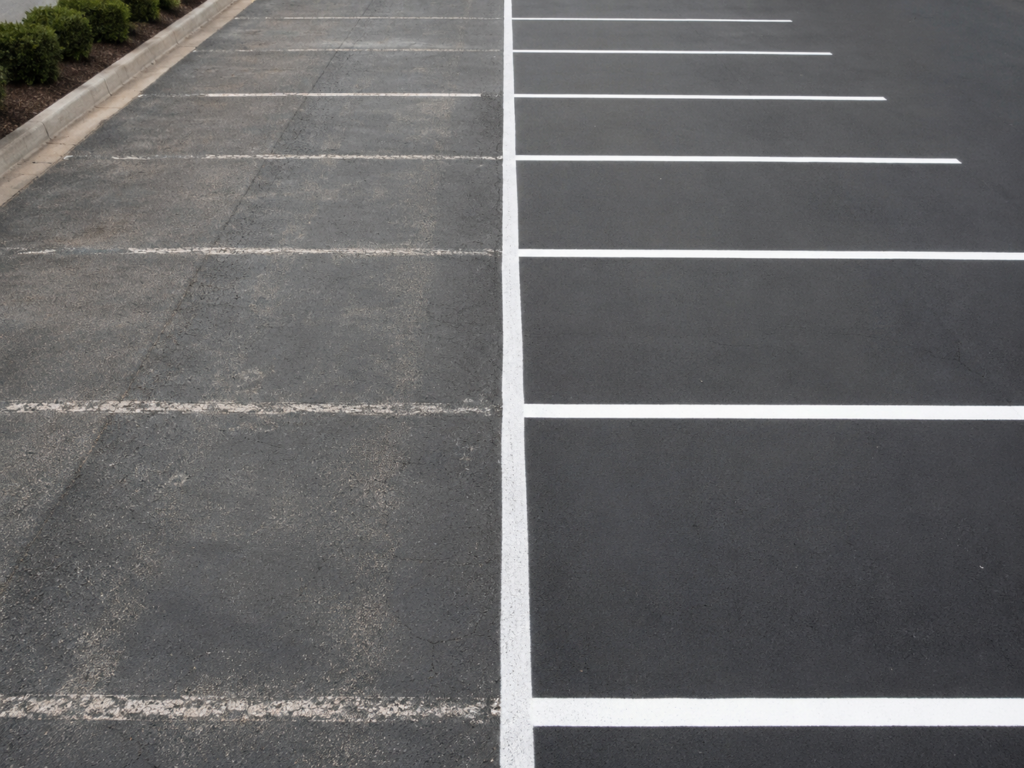
Asphalt ages slowly. Paint doesn’t get that luxury. It sits directly in the path of everything the lot experiences — tires grinding across it on every turn, UV breaking down the pigment, and in freeze-thaw states, snowplow blades scraping a little more off with each pass. Deicing salt adds a second front of attack, since the same chemicals that protect a surface from ice also degrade the paint sitting on top of it.
Traffic volume matters more than most people expect. A stall in a low-turnover office lot might hold its line for two or three years. The same paint at a drive-thru entrance, a loading dock apron, or any spot vehicles pivot across repeatedly can be visibly gone within a single season. This is why a lot can look “mostly fine” while its highest-traffic lanes have already failed — averages hide the worst spots.
Two Tests That Actually Tell You It’s Time
Daylight is the wrong test, and it’s the one almost everyone uses. Lines fade unevenly, and the human eye adapts to gradual change; a manager who walks the same lot daily often can’t see decline that a first-time visitor spots instantly.
The better test happens after dark. Drive the lot at night with headlights on. Federal standards actually address this directly — the FHWA’s pavement marking requirements call for markings to maintain a minimum level of retroreflectivity, the property that makes a painted line bounce headlight beams back at a driver instead of just absorbing them. Paint that reads as “a little dull” at 2 p.m. can be functionally invisible at 8 p.m., and that gap is exactly what most daytime walk-throughs miss.
Run a second test specifically on the accessible stalls, separate from the rest of the lot. Van-accessible markings, access aisles, and signage often fade at a different rate than general parking because of paint type or stencil wear, and a gap there isn’t cosmetic — it’s a standing liability regardless of how sharp the rest of the lot looks.
[Image 2 — suggested: striping crew mid-restripe with fresh yellow lines drying. Alt text: “professional crew performing parking lot line marking maintenance restripe”]
The Repaint That Doubles as a Compliance Deadline
Here’s the part that catches most property managers off guard: repainting isn’t purely cosmetic. Under ADA.gov’s own compliance brief on restriping, when a parking facility is restriped, its accessible spaces have to meet the current 2010 ADA Standards at that point — not whatever standard was in place when the lot was first painted or last touched up. A routine repaint can quietly turn into a compliance project if the accessible stall count, access aisle widths, or van-accessible ratio have drifted out of date since paint last went down.
There’s a silver lining buried in that requirement, though: federal guidance is explicit that restriping is inexpensive relative to almost any other accessibility upgrade, which is exactly why it’s expected to get corrected at every repaint rather than pushed off again. We’ve covered the specific space counts and dimensions in our dedicated guide to (internal link: ADA Parking Lot Compliance) — the point worth taking from this post is narrower: never schedule “just repaint the lines” as a purely cosmetic line item without also confirming the accessible layout underneath still matches current requirements. It’s the one maintenance task here that comes with its own deadline attached.
Paint or Thermoplastic: The Real Trade-off
The material decision made at install time quietly sets the maintenance clock for years afterward, and it’s worth understanding even if someone else made the original call.
Standard traffic paint is the default almost everywhere because it’s inexpensive and fast to apply. In a high-traffic climate with real winters, it commonly holds up well for one to two years before it needs real attention — sometimes less at pivot points and entrances. Thermoplastic costs meaningfully more upfront and needs specialized application equipment, but it’s a fundamentally tougher material, often lasting five years or more in the same conditions.
Neither choice is wrong. A low-traffic suburban office lot rarely justifies thermoplastic’s premium. A busy retail entrance repainted every eighteen months is often spending more over a decade than a single thermoplastic install would have cost. The honest advice is to match the material to the traffic, not to default to whatever was cheapest the first time.
What a Faded Lot Actually Costs You
The damage from worn markings rarely shows up as a single, obvious event. It shows up as friction. Diagonal parking that eats two spaces instead of one, because nobody can find the line. Towing disputes when a driver insists they were inside the stall. Fender-benders in unmarked drive lanes that get chalked up to “bad drivers” when the real cause is a lot that stopped telling anyone where to go.
There’s a slower cost too, tied to how faded markings read to anyone evaluating the property — tenants, prospective customers, a buyer walking the lot before close. Nobody consciously registers “the striping is six years old.” They register that the property feels a little unmanaged, and they can’t always say why. (internal link: Commercial Property Exterior Maintenance Guide) covers that broader perception problem in more depth.
Planning the Restripe
Order matters more than people assume. Paint needs a clean, dry surface to bond properly, and a lot swept the week before a restripe holds its lines noticeably longer than one painted over grit and debris — a recurring route from a crew like ProSweep is the cheap insurance that makes the more expensive service actually last. Timing matters just as much: most traffic paints need dry conditions and temperatures above 50°F to cure properly, which narrows the realistic window in colder climates to spring through early fall.
Professional crews handle the sequencing without much drama — a full sweep and surface prep, a laid-out plan for stalls and accessible markings, then a quick-drying application that reopens most of a lot within hours rather than days. Our own (internal link: Parking Lot Striping Complete Guide) walks through what to expect from that process end to end, and specialists like build their scheduling around exactly this seasonal window for commercial properties.
Treat It Like a Calendar Item, Not a Complaint Response
The properties that stay ahead of this don’t have better paint. They just stopped waiting for someone to mention it. Walk the lot at night once a season, check the accessible stalls on their own separate timeline, and match the material to how hard that section of pavement actually gets used. Parking lot line marking maintenance is one of the cheapest recurring line items on a commercial property, and one of the only ones where “we’ll get to it eventually” comes with a specific, visible — and occasionally legal — expiration date.
Leave a Reply