Concrete has a reputation for permanence, which is exactly why failing concrete surprises people. Every commercial property carries thousands of square feet of it — sidewalks, curbs, dumpster pads, drive aprons, loading docks — and all of it is cracking, scaling, or settling on its own quiet schedule. Commercial concrete repair is one of those line items property managers approve without much scrutiny, and parts of the industry know it: quick patches get sold, fail within two winters, and get sold again. This guide covers how to read the damage, which repairs actually hold, and when the honest answer is replacement.
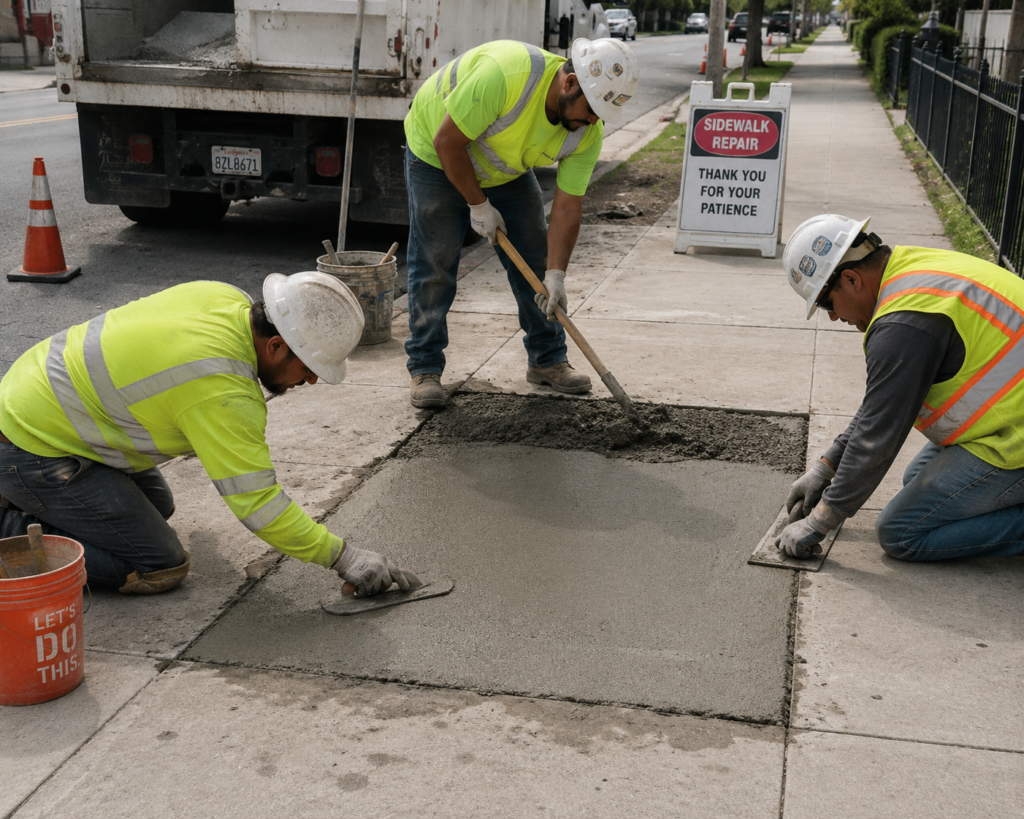
Reading the Damage Before Pricing the Fix
A repair only makes sense if the diagnosis came first, and concrete tells you plenty if you look.
Hairline cracks in a random map pattern are usually shrinkage — concrete shrinks as it cures, and it has cracked this way since the Romans. Control joints exist to steer that cracking into straight, tidy lines, so a fine crack wandering outside them is cosmetic more often than not. Cracks that are wide, growing, or offset in height are a different animal. Offset means the two sides have moved: the slab is settling or heaving, and something underneath has changed.
Spalling — the surface flaking or pitting away — points to freeze-thaw damage, deicing salts, or, in the worst case, corroding rebar expanding inside the slab and pushing the surface off. A panel that’s sinking, rocking, or ponding water has a support problem instead: washed-out base material or poorly compacted fill leaving a void below.
The distinction matters because surface fixes on support problems always fail. Patch a settling slab and you’ve bought a nicer-looking version of the same movement. That one distinction is where a commercial concrete repair budget is won or lost.
The Quarter-Inch Problem
Before pricing any commercial concrete repair, there’s liability — and with flatwork, it arrives in quarter-inch increments. Under the ADA standards, a vertical change in a walking surface up to a quarter inch is acceptable as-is. Between a quarter and a half inch, the edge must be beveled. Anything beyond a half inch needs a real treatment — a ramp-graded transition, not a paint stripe and good intentions.
That half-inch lip where a sidewalk panel heaved is the most common trip-and-fall exhibit in premises claims, and it’s usually the cheapest hazard on the property to eliminate. If you manage pedestrian surfaces, walk them twice a year with those numbers in mind. We covered the broader accessibility picture in our ADA guide (internal link: ADA Parking Lot Compliance).
Commercial Concrete Repair Methods That Actually Last
Most commercial concrete repair falls into a handful of techniques, and the difference between a five-year fix and a five-month one is almost always preparation.
Partial-depth patching handles spalls and surface failures. Done right, the crew sawcuts a clean perimeter around the damage, removes everything unsound, cleans the cavity, and places a proper repair mortar against squared edges. Done cheap, someone trowels a thin patch that feathers out to nothing — and thin, feathered concrete pops loose with the first hard freeze. If a proposed patch has no sawcut lines, it has no future.
Grinding is the underrated option. For a raised panel edge, grinding the lip flush costs a fraction of any alternative and removes the trip hazard the same day. The trade-offs are cosmetic — it exposes aggregate and leaves a visible scar — and it does nothing about why the panel moved, so it suits stable offsets, not active ones.
Cracks and failed joints get routed and sealed: the opening is widened into a clean reservoir and filled with a flexible sealant that moves with the slab. It isn’t glamorous. It’s also the single cheapest way to keep water out of the base, which is where the expensive problems start. The American Concrete Institute publishes the standards behind all of this if you want the deep end.
Settled Slabs: Lifting Instead of Replacing
When a slab has sunk but hasn’t broken, you often don’t need new concrete — you need the old concrete put back where it was. Two methods dominate.
Mudjacking pumps a cement slurry through drilled holes to raise the panel. It’s the cheaper route and it’s proven, but the holes are large, the material is heavy, and adding weight to soil that already failed is a genuine consideration. Polyurethane foam lifting pushes expanding foam through much smaller holes; it weighs a fraction as much, cures in minutes instead of a day, and costs more. Either approach commonly lands at half or less the price of tear-out and replacement.
Here’s the part contractors don’t always volunteer: lifting fixes the elevation, not the cause. If water is washing out the base — a bad downspout, a failed joint uphill — the void returns and so does the settlement. Fix the water first, or budget to do this twice.
[Image 2 — suggested: slab-lifting rig on a walkway with injection ports visible. Alt text: “commercial concrete repair by slab lifting on a settled walkway”]
What Commercial Concrete Repair Costs
Ranges, with the usual caveats about region and access. Grinding a trip hazard is typically the cheapest intervention here, often double digits per spot when done in batches. Routing and sealing runs a few dollars per linear foot. Slab lifting is usually quoted per project but commonly comes in 50 to 70 percent below replacement. Full replacement of commercial flatwork — tear-out, base correction, new pour — generally falls between $8 and $15 per square foot in 2026, climbing for thick pads, aprons, and dock areas.
The replace decision has two honest triggers. One is proportion: when a large share of a panel is failing, or the base under it has clearly gone, patching becomes a subscription. The other is structural — exposed and corroding rebar, full-depth cracking, slabs carrying truck loads they were never designed for. When replacement wins, replace whole panels to the existing joint lines; a patch that ends mid-panel telegraphs itself forever. And accept now that new concrete will never match the old gray. Nothing does. Anyone promising an invisible repair is selling something.
Winter Does the Damage. Fall Is When You Act
Freeze-thaw is the engine behind most of this. Water gets into cracks, joints, and porous surfaces, freezes, expands roughly nine percent, and pries the concrete apart — then does it again forty times a winter. Deicing salts make it worse twice over: they multiply the freeze-thaw cycles a surface endures and, over the years, drive chlorides down to the rebar. If you pour new concrete this season, keep salt off it entirely through its first winter.
The practical calendar writes itself from there. Walk your flatwork in late summer, seal every open crack and joint before the first freeze, and schedule patching while overnight temperatures still cooperate — concrete placement gets complicated below about 40°F. Commercial specialists like Hamilton County Concrete Repair book those pre-winter weeks solid for exactly this reason. The same freeze-thaw math applies to the asphalt beside your concrete, which has its own playbook (internal link: Commercial Asphalt Paving: A Property Manager’s Guide) — and in markets like central Indiana, paving-and-concrete firms such as Westfield Commercial Paving cover both surfaces under one contract.
The Reflexive Patch Is the Expensive One
None of this requires becoming a materials engineer. It requires refusing the automatic patch. Diagnose whether the problem is the surface or what’s underneath it, insist on sawcut edges and sealed joints, treat quarter-inch offsets as the legal matter they are, and let replacement win when the math says so. Concrete fails slowly and forgives planning. The properties that stay ahead of it fold flatwork into the same seasonal rhythm as everything else outside (internal link: Commercial Property Exterior Maintenance Guide) — and spend less on it over a decade than the properties that patch on demand.
Leave a Reply