Most property managers sign off on a commercial asphalt paving project two or three times in an entire career. It’s a six-figure decision, it disrupts every tenant on the property, and the result has to perform for fifteen to twenty years — yet most of us walk into it with less preparation than we give the annual landscaping bid. This guide walks through how a commercial repave actually works, from the dirt up, so you can plan the schedule, read the proposals, and skip the expensive version of learning on the job.
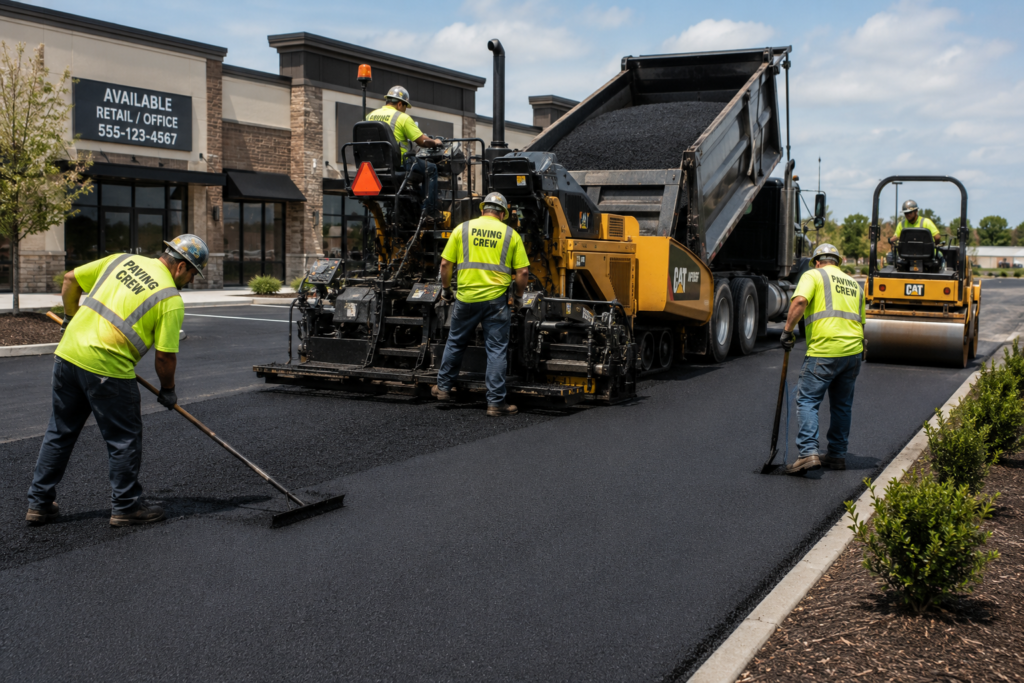
What Makes Commercial Asphalt Paving Different
The instinct is to picture a commercial lot as a very large driveway. It isn’t, and the difference is load. A residential driveway carries two cars. Your lot carries a 60,000-pound garbage truck every Tuesday, box trucks at the loading dock, and fire lanes that are legally required to support emergency apparatus.
Commercial asphalt paving is engineered around that traffic. Where a driveway might get two inches of asphalt over a thin gravel bed, a commercial installation typically runs three to six inches of hot mix over an engineered aggregate base — with heavier sections at dumpster pads, truck routes, and entrances where the punishment concentrates. Good contractors design by traffic load, not by square footage.
The other difference is that a lot is a system. Pavement, base, drainage, and markings work together, and a weakness in any one of them shortens the life of the rest.
The Layer You Never See Decides Everything
Here’s the uncomfortable truth of this industry: the asphalt you can see is rarely why a lot fails. The subgrade and base underneath decide almost everything.
Much of the country — and virtually all of the Midwest — sits on clay-heavy soil that holds water and moves when it freezes. If a contractor paves over soft, wet, or poorly compacted ground, the surface will telegraph it within a few winters: alligator cracking, rutting where trucks turn, low spots that pond after every rain. Everyone blames the asphalt. The asphalt was fine.
Proper base work means proof-rolling the subgrade with a loaded truck to find soft spots, undercutting and replacing the bad material, then building a compacted aggregate base thick enough for the traffic above it. The Asphalt Institute publishes design guidance on exactly this, and it’s worth skimming before you read bids.
One honest warning: base work is invisible in the finished product, which makes it the first thing a low bid quietly trims. You won’t see the difference at ribbon-cutting. You’ll see it in year four.
Mix, Thickness, and Why the Spec Sheet Matters
Hot mix asphalt isn’t one product. Mixes vary by aggregate size and binder grade, and a commercial job normally goes down in two lifts — a coarser binder course for strength, then a tighter surface course for smoothness and water resistance. Two properly compacted lifts will outlast a single thick one almost every time, because rollers can only achieve target density — usually 92 to 95 percent — through a limited depth of material.
When proposals arrive, the useful comparison isn’t the bottom line. Ask each bidder for the mix designation, the thickness of each lift, the base depth, and how compaction will be verified. A contractor doing this work correctly answers in one email. If a proposal fits on a single page with a single number, that’s information too. The National Asphalt Pavement Association is a solid reference for what a commercial specification should contain.
Paving Season Is Shorter Than You Think
Hot mix has to stay hot to compact, which means air and ground temperatures matter. Most specs call for 50°F and rising, so in freeze-thaw states the practical commercial asphalt paving season runs roughly April through November. That window fills faster than people expect, because everyone’s spring walk-through finds the same winter damage at the same time.
The scheduling advice is simple: get your site assessed in winter and your project booked before the season opens. Firms like Westfield Commercial Paving, which handles commercial lots across Hamilton County, Indiana, build their entire calendar around that thaw-to-freeze window — and the good slots go to the property managers who called in February, not July. Paving pushed too deep into fall risks cold-weather compaction problems that no warranty conversation will fully fix.
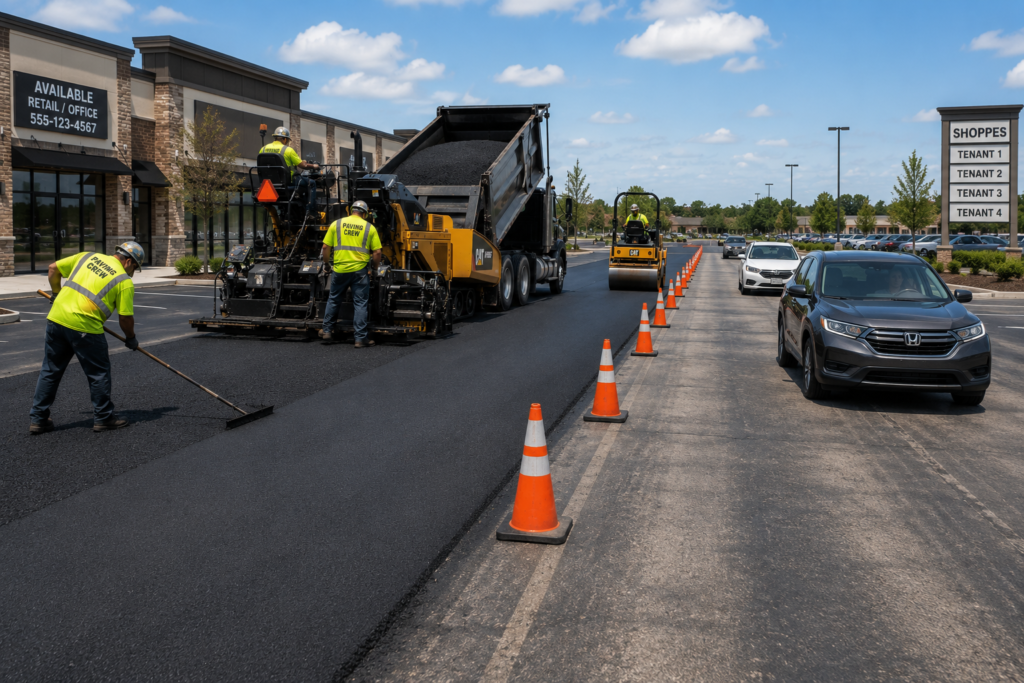
Paving a Property That Can’t Close
A commercial repave almost never happens on an empty site, and this is where contractors either earn their fee or reveal that they mostly do driveways. Retail centers get night and weekend pours so storefronts stay open. Office and HOA properties get section-by-section work with temporary striping to route traffic around the crews. Industrial sites get sequencing planned against truck schedules, because a blocked dock costs more than the pavement does.
Ask every bidder to explain their phasing plan in writing — how many phases, how access is maintained, how tenants or residents are notified, and how long each section cures before it reopens. Fresh asphalt will take light traffic within a day or two, but it stays tender in summer heat longer than people think. The phased paving programs that specialists run for retail, HOA, and industrial properties exist precisely because an unusable property is a failed project, no matter how good the new mat looks.
What Commercial Asphalt Paving Costs
Numbers first, hedges attached. In 2026, full-depth commercial asphalt paving commonly lands between $4 and $8 per square foot, with regional labor, oil prices, and — above all — base work driving the spread. A mill-and-overlay, where the top layers are ground off and repaved over a sound base, typically runs $2.50 to $5. When two bids on the same lot differ by 40 percent, the gap is almost never margin. It’s scope: one includes undercutting and base repair, and the other is paving over hope.
The overlay question deserves an honest answer, too. Over a sound base, an overlay is a legitimate, cost-effective renewal. Over a failed base, it’s a very expensive bandage — the cracks below reflect through within two or three seasons. A contractor willing to tell you an overlay won’t work on your lot is worth more than one who quotes it anyway. Right-sizing cuts the other way as well: a car-only lot doesn’t need truck-route thickness in every stall, and you shouldn’t pay for it.
After the Paver Leaves
The pavement is the beginning, not the end. New asphalt needs its markings, and it needs them planned — many crews lay temporary marks first, then return for permanent lines once the surface has cured and flashed off its oils. This is also the single best moment to get your ADA layout right, with accessible stalls, access aisles, and signage designed on a blank surface instead of retrofitted around old paint. We’ve covered the requirements in detail before (internal link: ADA Parking Lot Compliance), and dedicated layout crews like PrecisionLine Striping handle exactly this handoff.
Hold off on sealcoating, though — new asphalt should oxidize and cure for six to twelve months before its first coat. After that, the maintenance rhythm is familiar: crack sealing before winter, regular sweeping to keep grit and drain inlets under control, and restriping as the lines wear. Our striping guide (internal link: Parking Lot Striping Complete Guide) and exterior maintenance guide (internal link: Commercial Property Exterior Maintenance Guide) cover that ongoing side of ownership.
The Two-Week Window on a Twenty-Year Decision
A commercial asphalt paving project is a twenty-year decision made inside a two-week bid window, which is exactly why the preparation matters more than the paving. Understand the base, demand the specs, book the season early, and insist on a phasing plan that keeps your property alive while the work happens. Asphalt is a forgiving material with one condition attached: it rewards attention and punishes neglect on a schedule you can set your watch by. The property managers who come out ahead aren’t the ones who found the cheapest square-foot price. They’re the ones who knew what they were buying.
Leave a Reply